 Blocksquare
 real estate tokenization and BSPT rights
Blocksquare links real estate revenue rights to property-specific digital tokens through Ethereum smart contracts and an issuer’s corporate resolution. These Blocksquare Property Tokens, or BSPTs, represent claims on a defined share of property-related revenues net after taxes. Each asset has its own token contract, with transfer rules that reflect the issuer’s eligibility requirements. The wider infrastructure includes branded marketplaces, investor onboarding, secondary trading and revenue distribution. Its Oceanpoint ecosystem also supports participation through BST and staked BST, which serve different purposes from property tokens. The legal terms, capital stack and trading restrictions determine what a property-token position represents.
Updated onEach property’s corporate resolution defines the revenue rights behind its BSPT tokens, while issuer-set eligibility rules govern transfers.
BSPT issuance and economic rights
Property-specific contracts
Each property’s BSPT has its own Ethereum smart contract, so separate properties don’t share one interchangeable property token. The Property Factory creates these PropToken contracts using an ERC-20-compatible design. Each BSPT property contract has a maximum issuance of 100,000 tokens.
Token counts and royalty rights
The standard relates 1,000 tokens to 1% of the 100,000-token allocation. The economic interest behind that allocation comes from the royalty percentage that the issuer defines and seals in the contract. Token counts describe participation in those specified rights. The issuer sets the royalty percentage using the property’s business model and cost structure.
Tokenization can cover part or all of the relevant economic interest. Actual issuance and circulating supply can fall below the contract’s maximum.
The corporate resolution and property relationship
The corporate resolution creates the issuer’s financial obligation toward property-token holders. Its terms identify the asset and the relationship that connects the issuer to it. Corporate resolution v1.3 accommodates sole ownership, a commitment to exercise an option or right to purchase, or another specified relationship. The token’s financial claim therefore rests on the actual resolution and asset arrangement. The issuer’s property interest and the holder’s revenue entitlement remain distinct parts of the arrangement.
From deployed contract to linked resolution
The resolution identifies the deployed token contract, so its final Ethereum address must exist before the signed document can name it.
| Legal-link stage | Required condition or recorded result |
|---|---|
| Deploy the property token contract | An asset-specific PropToken contract establishes the Ethereum token address. |
| Prepare the corporate resolution | The document identifies the property and its deployed token contract. |
| Sign under shareholder authority | The issuer’s authorized legal representative signs the resolution. |
| Publish the signed file through IPFS | The signed document receives an IPFS identifier. |
| Record the document’s identifier | The PropToken contract stores the IPFS hash, completing the reciprocal link. |
The InterPlanetary File System (IPFS) identifies the particular file that the contract references. Linking the records makes the attached terms identifiable; the issuer remains responsible for fulfilling the financial obligations.
Who can hold and transfer BSPT tokens?
Holding BSPT requires completed know-your-customer (KYC) checks and a wallet that meets the issuer’s transfer conditions. The PropToken transfer function consults wallet information in the WhitelistingContract. Issuers can restrict ownership by residency or other eligibility criteria. The platform treats KYC as a one-time onboarding process, while the property issuer determines the conditions that govern its token transfers.
Those restrictions can narrow the number of potential trading counterparties and reduce liquidity. Identity approval and a completed trade address different requirements: eligibility permits participation, while a sale also needs a willing buyer. Public visibility exposes the token record; the issuer’s transfer conditions determine wallet eligibility.
Capital stack data and the property registry
A property’s capital stack records financing interests alongside the tokenization percentage. The contract’s fields cover senior equity, preferred equity, mezzanine, junior debt and senior debt. Issuers can update that information as financing changes, including changes in the balance between debt and equity. These fields describe the financing structure; they don’t establish that property-token holders outrank every other claimant.
The Property Registry registers each PropToken contract and makes property identification data publicly available. Contract information can include the street location, coordinates, property type and land-registry identifiers. These details distinguish the underlying asset from other properties. Its recorded financing can change over time without changing which physical asset the contract identifies.
Does a recorded valuation fix the token’s resale price?
A recorded valuation doesn’t fix a token’s resale price, because property appraisals and market trades measure different things. PropToken stores separate property and token valuations, which oracles can update. The token valuation model considers transaction prices, volume, property valuation and circulating supply. Sparse trading data can leave token prices vulnerable to manipulation. The separate property valuation provides another basis for assessing the asset when secondary-market activity offers limited pricing information.
Marketplace offerings and secondary trading
White-label marketplaces bring property listings, primary offerings and secondary trading into a branded investment interface. Operators can configure their branding, colors and language around the tokenization infrastructure. A primary offering makes property tokens available from the issuer, while secondary trading concerns tokens that holders offer for resale. Investor accounts support portfolio tracking, and operators can publish property information and investor reports. An admin panel provides the operator’s separate management interface.
Wallet compatibility remains selective. The platform supports selected self-custody wallets and account features for registering multiple wallets. An ERC-20-compatible token doesn’t establish that every wallet application works with the marketplace interface. Secondary-market access also remains subject to the property’s transfer restrictions. The ability to list an offer doesn’t establish an immediate buyer or an agreed exit price.
Revenue distribution and issuer buybacks
Revenue distribution follows the property’s royalty percentage and the commitments in its corporate resolution. The model bases those rights on the issuer’s property-related revenues net after taxes, including covered sale proceeds. The percentage describes the revenue allocation; it isn’t an annual yield or a percentage return on the token’s purchase price. The property’s actual revenue generation determines the amounts available under that arrangement. Corporate resolution v1.3 requires an interval of at least one month and payment no later than 30 days after each interval ends.
Corporate resolution v1.3 requires the issuer to buy back tokens before transactions involving the property, including a sale. The marketplace infrastructure provides smart contract tenders for repurchasing tokens. The applicable offer and resolution govern the repurchase terms. Announcing a tender and settling a holder’s payment are separate events; an offer alone doesn’t establish that the issuer has completed the buyback.
Licensing costs and token transfer fees
Marketplace access and usage charges
Blocksquare’s marketplace licensing explanation, published on March 12, 2026, separates software access from usage-based charges. A mandatory license can involve a one-time payment or installments. Installments spread the payments while preserving the full license obligation. Property tokenization and post-offering management create separate protocol costs, regardless of the method used to pay for the license.
Eligible partner staking can reduce license, tokenization and post-offering charges, provided the required staking level remains in place. The discount can reach 100% for qualifying categories. Secondary-market protocol transaction fees continue to apply, including at the highest discount tier. An operator can also add its own trading fee, separate from the underlying protocol charge.
Property-token deductions
The documented BSPT transfer model deducts 1.5% of the transferred property tokens from the amount credited to the buyer. The model allocates 0.5% of the transferred token amount to each of the marketplace operator, issuing company and Oceanpoint. It describes the deduction as applying even to transfers outside the platform. This token-based charge is distinct from a marketplace software license or an operator’s additional trading fee.
BST, sBST and the Oceanpoint ecosystem
Oceanpoint connects decentralized finance to tokenized real estate through Ethereum smart contracts. Its ecosystem includes pool participation and community governance alongside the property-token infrastructure.
BST is the ecosystem’s utility and governance token. Participation in Oceanpoint pools can earn BST under the applicable pool’s reward rules. That mechanism differs from the property revenues associated with a particular BSPT.
Staking BST in the Governance pool produces sBST, a tokenized share of that pool. Staked participation enables voting on Oceanpoint proposals through Snapshot.
Marketplace pools let community members pledge sBST to support a Certified Partner’s marketplace launch. Collective staking can provide access to qualifying infrastructure discounts when the required pool threshold remains satisfied. The software license remains necessary.
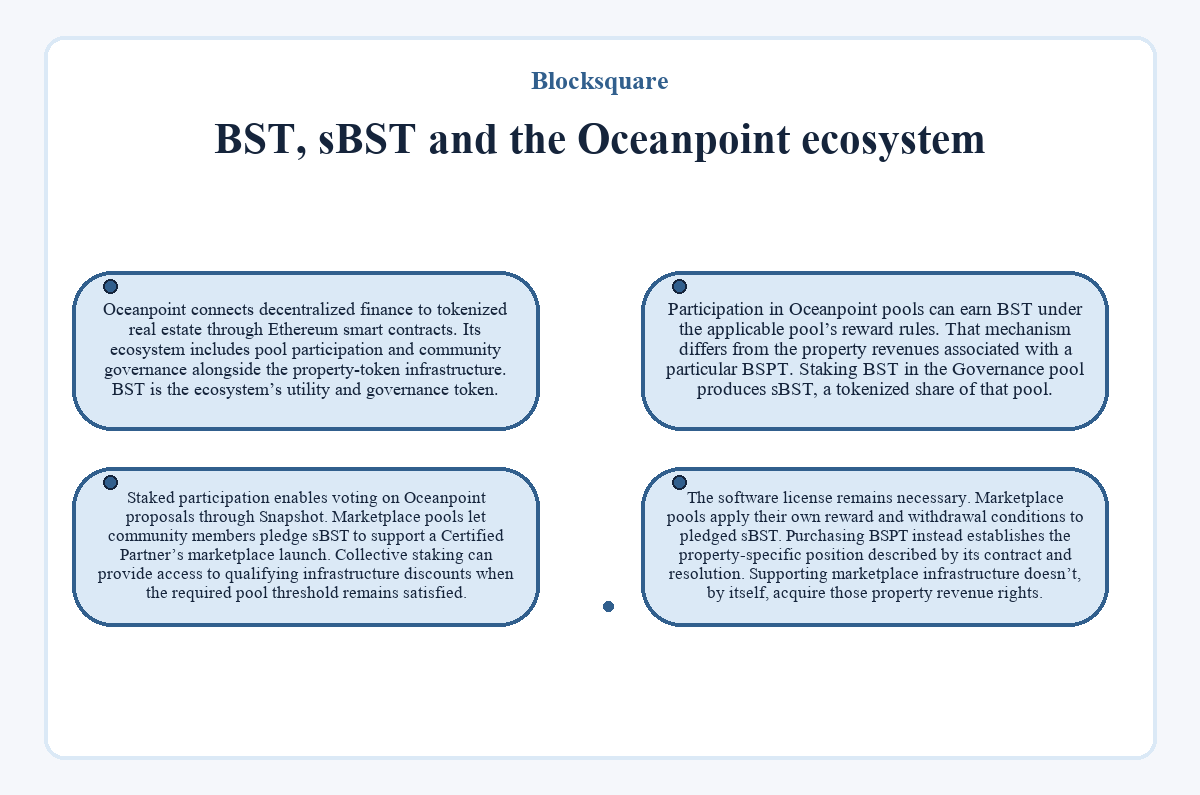
Marketplace pools apply their own reward and withdrawal conditions to pledged sBST. Purchasing BSPT instead establishes the property-specific position described by its contract and resolution. Supporting marketplace infrastructure doesn’t, by itself, acquire those property revenue rights.
Blocksquare FAQs
Are BSPT balances divisible into smaller units?
BSPT tokens use 18 decimal places in the ERC-20-compatible design. A token balance can therefore include fractional units. The 100,000-token issuance cap doesn’t mean that holders must transact only in whole tokens.
How can different property tokens share the BSPT prefix?
BSPT identifies the property-token standard, while the complete symbol distinguishes individual issuances. The documented symbol includes a unique alphanumeric element and an incrementing number. The specific contract address identifies the token contract behind that symbol.
What limit applies to wallets registered with a marketplace account?
The documented marketplace platform supports up to 10 registered digital wallets per account. Registration and token eligibility remain separate conditions. Each wallet must still meet the applicable transfer requirements, and the interface supports selected self-custody wallets.
Does the marketplace platform support euro investments through bank accounts?
The platform includes a feature for adding bank accounts to make investments in EUR. Bank funding availability depends on the individual offering’s purchase terms.
Who pays for property appraisals under corporate resolution v1.3?
The property owner bears the appraisal cost under corporate resolution v1.3. Its terms require a report no older than 12 months, available to existing token holders on request, from a licensed valuer registered with IVSC, RICS or an equivalent organization.
Will a change of issuer shareholders remove the property-token obligations?
Corporate resolution v1.3 requires incoming shareholders to adopt its obligations when acquiring their shares. The outgoing shareholders must inform them about the resolution. A change of shareholders therefore doesn’t, by itself, cancel the documented commitments.
Is a secondary-market price the minimum issuer buyback price?
On withdrawal of corporate resolution v1.3, the repurchase price can’t be lower than the highest price at which the issuer has ever offered or sold tokens. The accompanying explanation identifies primary-market pricing, so a holder’s higher secondary-market purchase price doesn’t automatically set that floor.